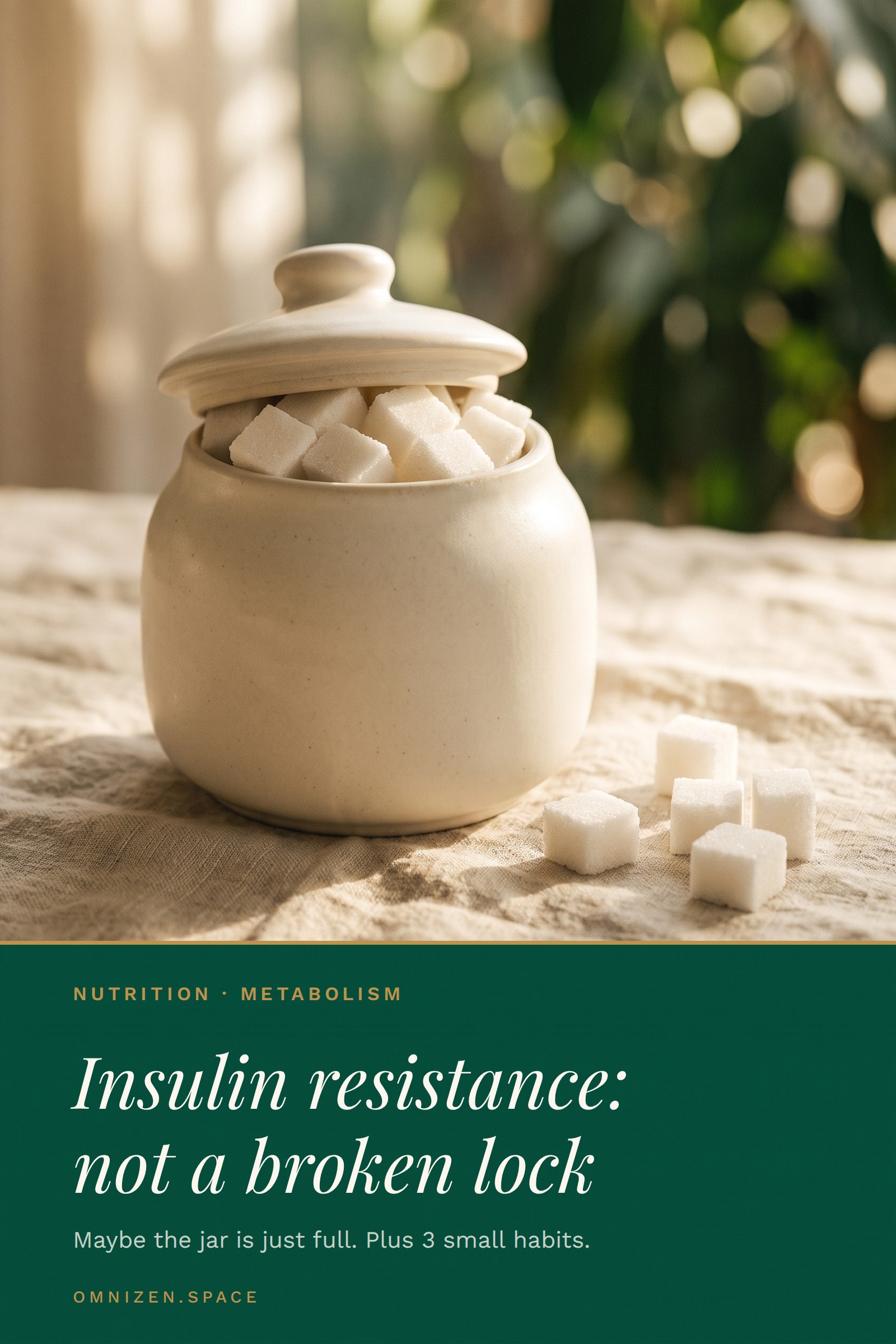
Most of us learned about insulin resistance through the same picture. Your cells are locked doors. Insulin is the key. When you become resistant, the lock rusts and the key stops turning.
It is tidy and easy to remember. It is also incomplete.
Here is another way to see it, and it changes how the whole thing feels. Maybe the lock is fine. Maybe the jar is already full, and the cell is closing the lid on purpose.
That is not a way of saying insulin resistance is harmless. Over years it wears on the pancreas and raises the risk of type 2 diabetes. But there is a real difference between seeing your body as a broken machine and seeing it as a system trying to protect itself from overload. The first leads to shame. The second leads to curiosity, and to small changes you can actually keep.
First, a clear line
This post has nothing to do with the scale, weight loss or BMI. It is about the metabolic engineering running inside you every second.
And as always: nothing here is medical advice. If you suspect insulin resistance, prediabetes or diabetes, talk to your doctor about testing. If you take diabetes medication or insulin, do not change your meal timing or exercise routine without talking to them first.
Why this happens: the full jar
Picture your cells as airtight food storage containers. Glucose in your blood is the sugar cubes waiting to be packed in. Insulin is the mechanism that opens the lid and loads them.
In the old model, the problem is the lid. Rusted lock, useless key.
In the newer view, the problem is the jar. It is already packed to the top. When a cell is past capacity, taking in more fuel puts extra strain on its internal machinery, the mitochondria. So the cell closes the lid to protect itself.
This is more than a nice metaphor. In an influential 2015 paper in Diabetes, researchers framed insulin resistance as a physiological defense against nutrient overload. It is one model, it is debated, and it does not explain every case. But it changes the question from "why am I broken?" to "what is my body protecting me from?"
Why your blood work can look normal
Once the cell closes the lid, glucose starts to build up in the blood. The pancreas reads that as an emergency and sends out more insulin to force the lids open.
Here is the strange part: for a long time, this works. Blood sugar stays in the normal range. A fasting glucose test can come back fine. Meanwhile the pancreas is working harder and harder and insulin levels in the blood are climbing.
Think of a dashboard where every gauge reads normal while the engine runs hot. That is why insulin resistance is often a quiet process that unfolds over years. Your doctor may order tests like fasting insulin or HOMA-IR to see more of the picture, but that call is theirs.
High insulin is a powerful growth and storage signal. Darkened skin at the neck or armpits, multiplying skin tags and polycystic ovary syndrome (PCOS) are all known to be linked with high insulin. None of these diagnoses anything on its own, but each is a good reason to bring it up with your doctor.
Why the scale can mislead you
Someone who looks slim can carry fat around their organs (visceral fat) and have significant insulin resistance. Someone with a higher number on the scale can be metabolically flexible.
The number that matters is not your weight. It is how hard the system inside is working. We looked at how ultra-processed food can push fat into muscle itself in our post on hidden muscle fat.

What actually helps: three habits, ranked
If you only do one, do the first. It takes the least effort and works with whatever you already eat.
1. Walk for 10 to 15 minutes after your biggest meal
Your muscles have a little-known trick: when they contract, they can pull glucose out of the blood with much less help from insulin. Contraction moves glucose transporters to the cell surface through a separate pathway. It is a back door into the jar.
So the easiest move after a heavy meal is a 10 to 15 minute walk at an easy, steady pace. A 2022 meta-analysis in Sports Medicine found that even short, light walks after eating meaningfully lowered post-meal blood sugar.
Does that mean you should hit the gym hard right after dinner instead? Not necessarily. Very intense exercise on a full stomach can push stress hormones up and briefly raise blood sugar. That does not make strength training bad: done regularly, it improves insulin sensitivity over the long run. It just means that right after a meal, a calm walk is the easiest win. If you want it to double as a mental reset, our 10-minute nature break post shows how.
Stuck at your desk? Raise and lower your heels in a steady rhythm. The soleus, a deep calf muscle, makes up only about 1% of your body weight, but in a 2022 study from the University of Houston it drew very little on its own glycogen stores during this movement and ran mostly on glucose and fat from the blood. It was a small study, so treat it as promising rather than proven. It is still the most effortless thing you can do under a desk.
2. Close the kitchen 3 to 4 hours before bed
Sleep and blood sugar are more connected than most people think.
A short or broken night registers as stress. Stress hormones release glucose and make cells less responsive to insulin. In one 2010 study, a single night of restricted sleep measurably reduced insulin sensitivity in healthy adults. We explored how one person's bad night spills into the whole household's eating in our post on your partner's sleep.
The second player is melatonin, the hormone that rises in the dark. It tells the pancreas to slow down insulin release, which makes sense for a body expecting to fast overnight. A late snack of sweets or crackers arrives just as the doors are closing. A 2022 trial in Diabetes Care found that eating dinner late, while melatonin was high, impaired glucose tolerance, especially in people carrying a common melatonin receptor gene variant.
Digestion also generates heat, and your body needs to cool down to reach deep sleep. If you tend to lie awake feeling wired, our post on being wired but tired covers the evening side of this.
In practice: finish your last meal 3 to 4 hours before bed, and keep your bedroom dark and cool.
A caveat: if you work night shifts, take diabetes medication or insulin, or tend to have low blood sugar at night, this rule may not fit you. Plan your evening meal with your doctor.
3. Change the order, not the menu
Much of diet culture treats insulin as the enemy: zero carbs, never touch bread, stay hungry. But insulin is essential for survival and for building muscle, and cutting carbs out entirely is neither necessary nor realistic for most people.
The goal is not to remove carbohydrates. It is to slow down how fast they reach your blood.
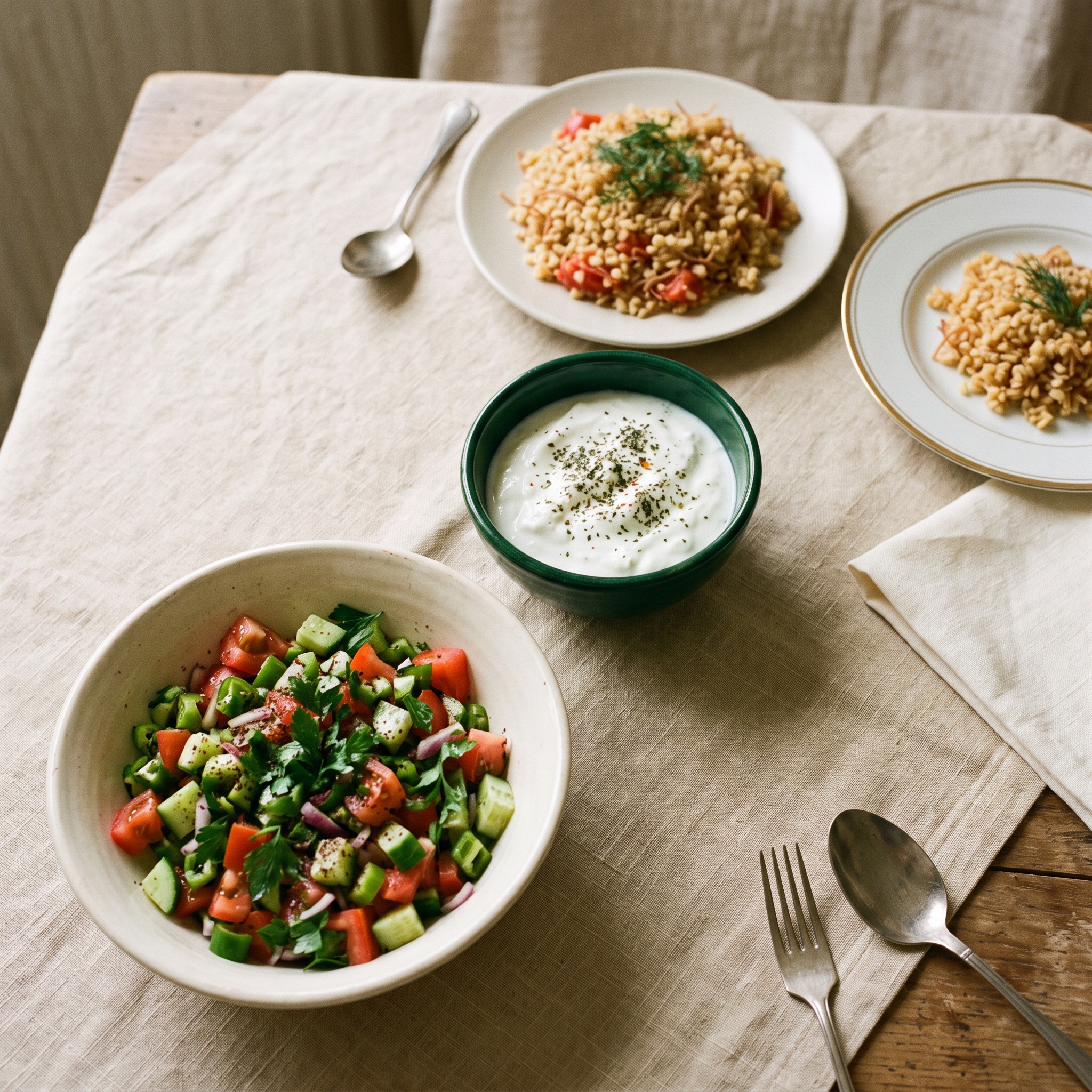
White bread, plain rice or a sweet drink on an empty stomach hits your bloodstream like a wave. Put fiber and protein in front of them and the rules change. Fiber and protein form a kind of mesh in the stomach and gut, and the carbs that follow have to filter through it slowly.
| Order | What | Examples |
|---|---|---|
| 1 | Fiber | Salad, greens, roasted or cooked vegetables |
| 2 | Protein | Yogurt, fish, chicken, eggs, cheese, beans |
| 3 | Carbohydrates | Rice, bread, pasta, and dessert last |
In a 2015 study, people with type 2 diabetes who ate the exact same meal in this order had markedly lower blood sugar and insulin after eating. A later study in prediabetes found similar results. Both were small, but the habit costs nothing. Blood sugar swings can also shape how anxious you feel, which we covered in our post on anxiety and diet.
A one-week micro plan
You do not need all three. Pick one and try it for a week.
| Day | Habit | Check-in |
|---|---|---|
| Monday | Walk 10 minutes after dinner | How do you feel an hour later? |
| Tuesday | Eat your salad before anything else at dinner | Notice how full you feel before the rice |
| Wednesday | Set a "kitchen closed" time 3 hours before bed | Was it hard? What did you miss? |
| Every workday | Heel raises at your desk after lunch | Set a reminder for 2pm |
| Sunday | Ask yourself: "Which habit felt easiest to keep?" | Keep that one next week |
The bigger picture: software written for scarcity
For most of human history, food was scarce. Winters were long and hunger was ordinary. One hypothesis holds that bodies able to store energy quickly, closing the doors early and saving every bit of fuel, had the edge.
This "thrifty gene" idea is debated today and should be read as a hypothesis, not a law. But it offers a useful frame: maybe your body is not broken. Maybe it is running survival software written for scarcity in a world where food never runs out.
That frame does not remove responsibility. It removes shame. And habits built without shame tend to last a lot longer.
When this is not the answer
Habits are a foundation, not a treatment. See your doctor if:
- You are unusually thirsty, urinating more often or tired for no clear reason
- You notice new darkened, velvety skin at your neck, armpits or groin
- You have irregular periods, a PCOS diagnosis or a history of gestational diabetes
- Type 2 diabetes runs in your family and you have never had your blood sugar checked
- You take diabetes medication or insulin and want to change your eating pattern A basic blood panel (fasting glucose, A1C and, if your doctor thinks it is useful, fasting insulin) is a sensible first step.
Frequently asked questions
What is insulin resistance? Insulin resistance means your cells respond less strongly to insulin, so the pancreas has to produce more of it to keep blood sugar in range. Some researchers also describe it as a protective response by cells facing more fuel than they can safely handle.
Can you have insulin resistance with normal blood sugar? Yes. The pancreas can keep blood sugar normal for years by producing extra insulin, so insulin resistance often does not show up on a fasting glucose test early on. Your doctor can decide whether other tests are useful.
Does walking after eating lower blood sugar? Yes. Research shows that even short, light walks after a meal reduce post-meal blood sugar, because working muscles can take up glucose with less need for insulin. Ten to fifteen minutes is a practical target.
Is eating late bad for blood sugar? Eating late, when melatonin is high, has been shown to impair glucose tolerance because melatonin slows insulin release. Finishing your last meal three to four hours before bed is a reasonable habit for most people.
Does the order you eat food in matter? Small studies show that eating vegetables and protein before carbohydrates at the same meal lowers the rise in blood sugar and insulin afterward. It is one of the easiest changes because nothing is off the menu.
The next time you look in the mirror and think your body is failing you, try a different question: what is my body trying to protect me from?
The answer might start with a fifteen-minute walk after dinner.
This article is for general information and is not medical advice. Please talk to your doctor about diagnosis and treatment.
Which of the three habits feels most doable for you this week?