
A headline crosses your feed in October: pomegranate clears out your arteries.
You have seen enough of these to know the shape of the disappointment that follows. Usually the study turns out to be eight rats, or a cell culture, or a supplement company's own trial.
This one is more interesting than that, and also less impressive than the headline. The finding is real, the mechanism is well described, and the most useful part of it has almost nothing to do with the fruit. It has to do with whether your gut can do a specific piece of chemistry that roughly one in ten adults cannot do at all.
What happens when you eat a pomegranate
The relevant compounds in pomegranate are polyphenols called ellagitannins, with punicalagin as the headline molecule. Walnuts, raspberries, blackberries and strawberries contain them too.
Here is the part that matters: these molecules barely get absorbed. They are large, they pass through the small intestine mostly intact, and they arrive in your colon more or less unchanged.
That is where your gut bacteria take over. They break ellagitannins down into ellagic acid, then convert that, step by step, into a family of compounds called urolithins. The bacteria involved include Gordonibacter urolithinfaciens, Gordonibacter pamelaeae, and species of Ellagibacter and Enterocloster. It usually takes more than one organism: one produces an intermediate, another picks it up. A cross-feeding chain.
The most biologically active endpoint of that chain is urolithin A. Every study you are about to read is about urolithin A, not about pomegranate.
So the compound doing the work is not in the fruit. Your microbiome makes it.
Not everyone makes it
This is the part most coverage skips, and it is the part that should change how you read every pomegranate study ever published.
People sort into three urolithin metabotypes:
| Metabotype | What the gut produces | Prevalence in adults |
|---|---|---|
| UM-A | Mainly urolithin A | roughly 50 to 80 percent |
| UM-B | Urolithin A plus isourolithin A and urolithin B | roughly 10 to 40 percent |
| UM-0 | No meaningful urolithin production | roughly 10 percent |
Those ranges come from a Spanish cohort of 839 people, summarized in a 2024 review in Food & Function. The same work found the proportion of UM-A declines with age while UM-B rises, and UM-0 stays roughly constant.
Two people can eat the same pomegranate and end up with different molecules in circulation. If you are UM-0, you produce essentially none of the compound the research is about.
This alone explains some of the noise in the human literature. A trial that does not stratify by metabotype is averaging producers and non-producers together, which is a reliable way to wash out a real effect.
You cannot find out your metabotype from a standard lab panel. Urinary urolithin profiling exists in research settings and is not a routine clinical test.
The 2026 study, in detail
The work driving the current headlines came out of Cardiff University, from the lab of Professor Dipak Ramji, and was published in Antioxidants in 2026 (volume 15, issue 4, article 507).
It ran in two stages. First, cell work: punicalagin and its metabolites were tested on macrophages and endothelial cells, and urolithin A came out as the most effective, so it was carried forward. Second, an animal stage.
The model was LDL receptor deficient mice (LDLr⁻/⁻), a standard model for atherosclerosis because these animals develop plaque reliably. The mice received 50 mg/kg/day of urolithin A for 12 weeks. The authors calculate the human equivalent dose at roughly 4 mg/kg/day.
What changed:
- Plaque burden decreased. Smaller lesions overall.
- Lipid content in the plaque decreased.
- Inflammatory cells decreased. Fewer macrophages and fewer CD3+ T cells infiltrating the lesions.
- Stability markers increased. More smooth muscle cells, more collagen.
- Cholesterol did not change. Total, LDL, HDL and triglycerides stayed where they were. Ramji's summary: supplementation produced "smaller, less inflamed and more stable plaques with reduced potential for rupture."
Those last two bullets are the interesting ones, and they are worth sitting with.
Why stability matters more than size. Most heart attacks are not caused by a plaque slowly closing an artery like a clogged pipe. They are caused by a moderately sized plaque with a thin fibrous cap that ruptures, exposing its contents to the blood and triggering a clot that occludes the vessel in minutes. Collagen and smooth muscle cells are what thicken that cap. A plaque that gets more fibrous is a plaque less likely to break.
Why unchanged cholesterol matters. If the benefit ran through lipids, urolithin A would just be a weak statin and not especially interesting. The lipid panel not moving suggests the pathway is inflammatory, which is the same territory as canakinumab and colchicine, two drugs that reduced cardiovascular events without touching LDL.
That is a genuinely coherent mechanistic story. It is also, still, a mouse story.
What the human data says
Less than you would hope.
Aviram 2004. Patients with carotid stenosis drank pomegranate juice for up to three years, and the authors reported a reduction in carotid intima-media thickness along with lower blood pressure. The trial was tiny and not well controlled. It is frequently cited and should be weighted accordingly.
Davidson 2009. This is the one that matters more. A randomized trial of 289 people at moderate coronary risk, given 240 mL/day of pomegranate juice or a control beverage for up to 18 months, published in the American Journal of Cardiology. Result: no significant difference in overall CIMT progression. Exploratory subgroup analyses found slowed progression in participants who started with elevated oxidative stress and an adverse triglyceride to HDL profile. Subgroup analyses generate hypotheses. They do not settle them.
Urolithin A supplement trials. Doses of 500 to 1,000 mg daily have been tested for up to six months, mostly for muscle and mitochondrial endpoints. Results are mixed: improvements in hand and leg muscle endurance and in mitochondrial biomarkers, but several primary endpoints, including six-minute walk distance, came back neutral. One trial reported improvement in cardiovascular-related biomarkers. No trial has measured a cardiovascular disease outcome.
So: strong mechanism, good animal data, thin human data. If you are the kind of reader who wants the honest summary in one line, that is it.
What to actually do about it
Ranked. If you do one thing, do the first.
1. Eat ellagitannin foods three or four times a week
Not because the evidence is conclusive, but because the cost is a handful of walnuts and the downside is zero. Approximate ellagitannin content, from the 2026 Frontiers in Nutrition review:
| Food | Ellagitannins |
|---|---|
| Pomegranate juice | ~1,370 mg/L |
| Raspberries | 47 to 270 mg/100 g |
| Blackberries | ~150 mg/100 g |
| Strawberries | 31 to 184 mg/100 g |
| Walnuts | ~59 mg/100 g |
| Tea | 0.59 to 17.89 mg/cup |
Consistency beats quantity here. The conversion depends on bacteria that respond to regular substrate.
2. Eat the fruit, not the juice
Juice delivers the ellagitannins and a concentrated sugar load with no fiber. Fiber is not incidental to this story: it feeds the ecosystem doing the conversion. If you drink the juice, keep the glass small.
3. Feed plant diversity, not just one superfood
The bacteria that make urolithin A live in a community. A practical target is 30 different plant foods a week, counting herbs, spices, nuts and legumes, which makes it much easier than it sounds.
4. Do not lead with the supplement
Urolithin A supplements exist and have real human trial data behind them, just not for arteries. Taking the end product also does nothing for the microbiome that would otherwise produce it. If you are considering one, raise it with your doctor first, particularly if you take an anticoagulant.
5. Pull the inflammation levers that have better evidence
What urolithin A did in mice was lower vascular inflammation. Things with stronger human evidence that point the same direction are already available to you, including cutting back on ultra-processed food. Our piece on ultra-processed food and hidden muscle fat covers a related finding.
6. Keep the big levers in view
Blood pressure, smoking, glucose, 150 minutes a week of moderate activity, sleep, and whatever your doctor has prescribed. If chronic stress and poor sleep are the honest problem, wired but tired is the more useful place to start than a fruit bowl. The easiest way to accumulate those 150 minutes is covered in the 10-minute nature break, and if your nights are being disrupted by someone else's, your partner's bad night explains how that reaches your plate too.
A one-week plan
| Day | Add | Note |
|---|---|---|
| Monday | A handful of walnuts with breakfast | Zero prep, easiest possible start |
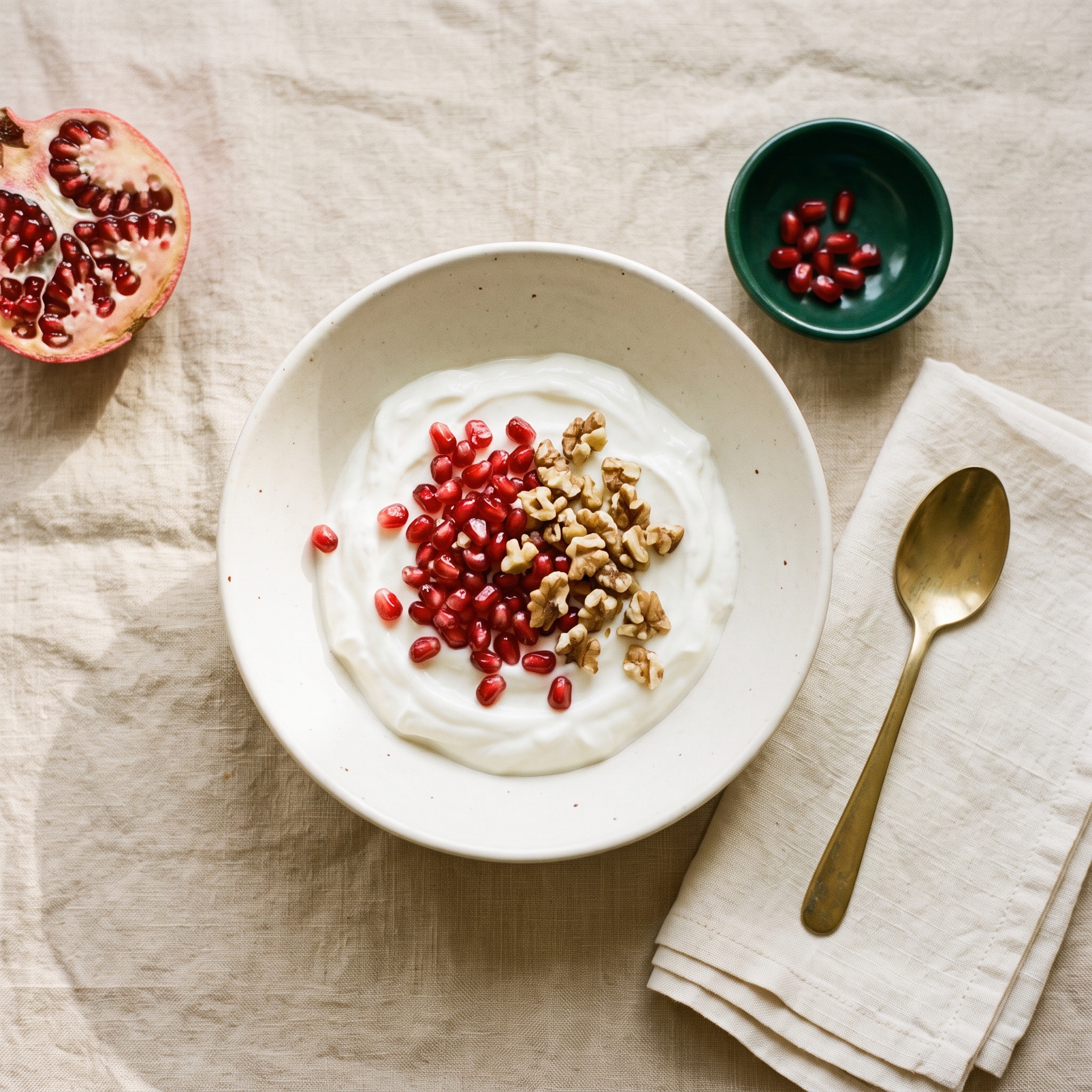
| Wednesday | Pomegranate seeds on yogurt | Deseed one, keep it covered in the fridge |
| Friday | A bowl of raspberries or blackberries | Frozen counts and costs less out of season |
| Sunday | Ask yourself: how many different plants did I eat this week? | Under 20, add a legume next week |
When this is not the answer
This is a nutrition article, not treatment advice. See a doctor rather than adjusting your fruit intake if you have:
- Chest pain, pressure or unusual shortness of breath with exertion
- Cramping leg pain when walking that stops when you rest
- A family history of early heart disease and no lipid panel on record
- Repeated high blood pressure readings at home
- Any prescription for a statin, an anticoagulant or blood pressure medication, combined with a plan to add large amounts of pomegranate juice to your routine There is an ongoing discussion about whether pomegranate juice interacts with certain medications. It is worth a direct question to your physician or pharmacist rather than an assumption either way.
Frequently asked questions
Does pomegranate clean out your arteries? No. No food mechanically removes arterial plaque. A 2026 study in Antioxidants found that urolithin A, a gut metabolite of pomegranate compounds, reduced plaque size and increased plaque stability in mice. That result has not been replicated in humans.
What is urolithin A? A compound produced by gut bacteria from ellagitannins found in pomegranate, walnuts, raspberries, blackberries and strawberries. It is not present in the food itself. Your microbiome makes it.
Can everyone produce urolithin A? No. Roughly 50 to 80 percent of adults produce substantial urolithin A, and about 10 percent produce none in meaningful amounts. The distribution shifts with age, with the high-producer group shrinking over time.
Is pomegranate juice as good as the fruit? Generally not. Juice carries the polyphenols without the fiber and with concentrated sugar. Fiber supports the bacterial community that performs the conversion.
Should I take a urolithin A supplement? Human trials at 500 to 1,000 mg daily have shown improvements in muscle endurance and mitochondrial biomarkers, with several primary endpoints neutral. No trial has tested artery outcomes. Talk to your doctor first, especially if you take any regular medication.
How long until I would see an effect? There is no honest answer, because no human trial has measured a cardiovascular outcome. Treat pomegranate and berries as part of a good diet rather than an intervention with a timeline.
The most useful thing in this research is not the fruit. It is the reminder that a food's effect can depend on a chemistry set you happen to be carrying, or not carrying, in your gut.
Everything here is general information and is not medical advice. If you have concerns about your heart or your vascular health, talk to your doctor.
What is one food you would actually keep eating, not because a study said so, but because you like it?
Related reading
- Ultra-Processed Food and Hidden Muscle Fat · the other large inflammation lever, with stronger human data
- Wired But Tired · what chronic stress physiology actually looks like
- The 10-Minute Nature Break · the easiest way to hit the movement target above