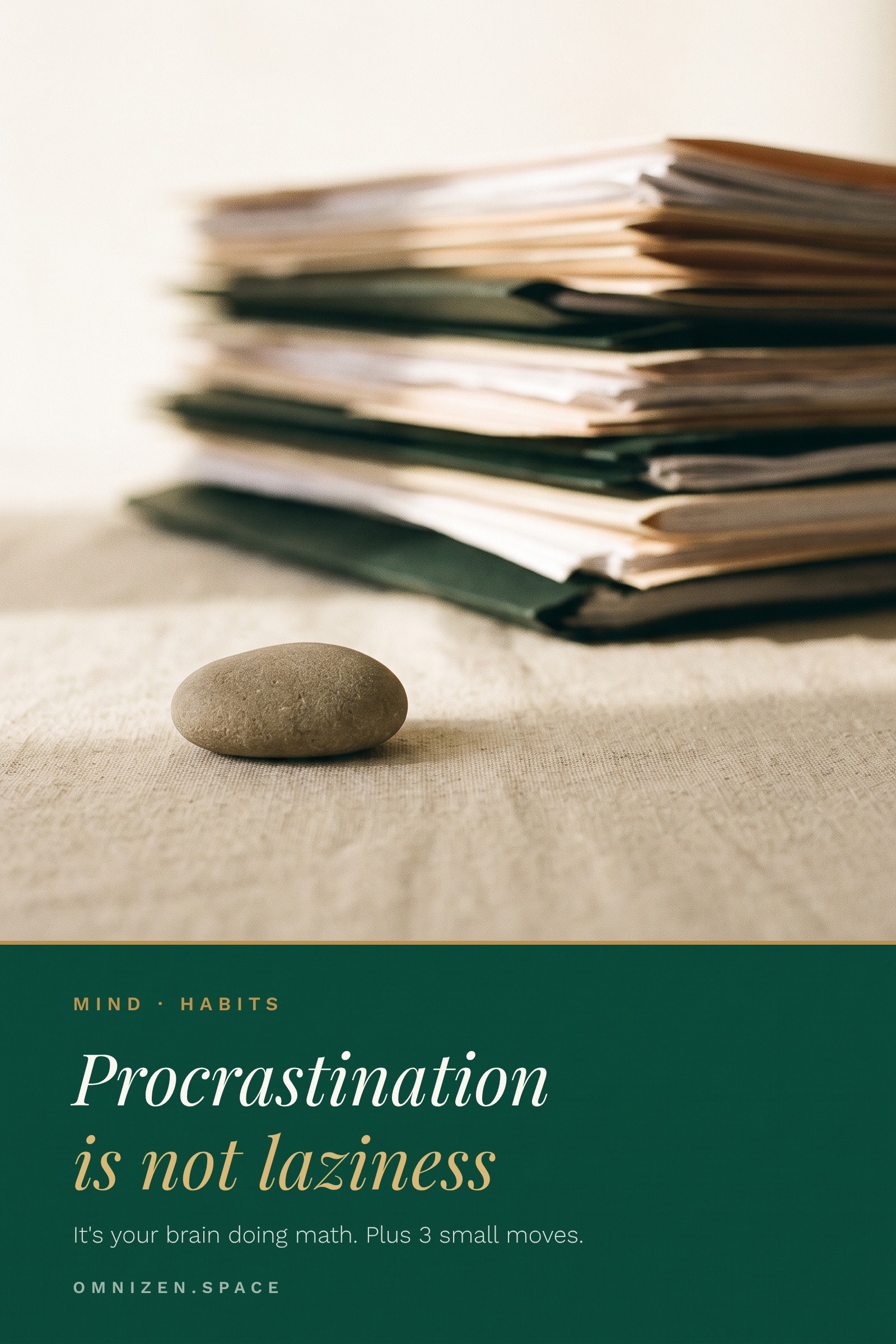
The task has been sitting on your desk for three days. You know exactly what it is. You have even opened the file once. And yet here you are, on the couch, phone in hand, running the same line in your head: why can't I just start?
Right behind that line comes a harsher one. I'm lazy. I have no discipline. This is just who I am.
This post is about the second line, because the research does not support it. Procrastination looks a lot less like a character flaw and a lot more like a calculation, one your brain runs every time you consider doing something. And unlike character, calculations can be changed.
First, a clear line
Nothing here is medical or psychological advice.
If you have ADHD, some of these ideas may still be useful, but they do not replace the guidance of your clinician or your treatment. Trouble starting tasks in ADHD involves different mechanisms.
And if you have felt flat for weeks, with nothing pulling you, including things you used to enjoy, that may not be ordinary procrastination. It is worth talking to a doctor or therapist.
Why this happens: the accountant in your head
Picture a very cautious accountant living in your skull, calculator always running. The moment you think about sending a short email or going for a walk after work, this accountant runs one equation: is the effort going to be worth the reward?
Researchers call this effort-based decision making. Before you act, your brain weighs what an action will cost against what it will pay.
The accountant is stingy for a reason. For most of human history, calories were scarce and wasting energy could be dangerous. A brain that refused to spend effort on low-value tasks had an edge. Today, that same cautious system applies the same scrutiny to a tax form or a slide deck.
A 2022 study from the Paris Brain Institute looked at this calculation in procrastination directly. In 51 adults, the people who procrastinated most were not especially drawn to immediate rewards. Instead, they discounted future effort more steeply: work scheduled for tomorrow felt much lighter than the same work today. That is the brain's version of "it will be easier later." The model was good enough to predict how long participants took to return a set of tedious forms to get paid. In the brain scans, a region at the front of the brain (the dorsomedial prefrontal cortex, often called the dorsal anterior cingulate) tracked how that delayed effort was weighed.
The gate between wanting and doing
Wanting to do something and actually starting it are not the same process. There is a gate in between.
Deep in the brain, beneath the cortex, a set of structures called the basal ganglia helps choose which intentions become actions. One of the key chemical signals in this circuit is dopamine.
A striking case shows how much this gate matters. In 2013, a team at Oxford led by neurologist Masud Husain described a 41-year-old man who had small strokes in part of the basal ganglia. Over months, he lost interest in almost everything. He lost his job. He stopped seeing people. His depression scores were in the normal range. When asked if he would like to listen to music, he said yes. Setting up the stereo simply felt like too much effort.
Treated by his doctors with a medication that acts on the dopamine system, he improved markedly and found work again.
This is a rare neurological condition, not everyday procrastination, and the answer to procrastination is not a pill. But the case makes one point vividly: motivation is not only a matter of willpower. Wanting and starting are separate jobs in the brain.
"But I can game for three hours"
Here is the objection you are probably already making. You avoid the report for hours while playing a hard video game with total focus. You fall down a research rabbit hole online. You deep clean the kitchen.
If this were simply a lack of motivation, where is all that energy coming from?
The answer: your brain is not failing to motivate. The accountant is running a different equation for each task. In a game, the reward is instant and clear. A cleaner kitchen is visible progress. The report is big effort for a reward that is distant and vague. Same brain, different math.
A 2016 brain imaging study from Oxford adds an interesting piece. Forty young volunteers chose whether to accept offers that paired different amounts of physical effort with different rewards. People with lower motivation turned down effortful offers more often. But when they did accept, brain areas involved in preparing action were more active in them than in highly motivated people. The researchers suggested that turning a decision into action may cost them more.
You will see this study described online as proof that procrastinators "burn more energy" or "use more glucose." It does not show that. Brain imaging of this kind measures changes in blood flow, not fuel consumption, and the participants were sorted by apathy scores, not procrastination habits. What it does suggest is softer and still useful: the moment of deciding and starting can feel effortful in its own right. Sitting at the bottom of the hill, going back and forth, is not rest.

Activation energy: the hill you are looking at
Chemists use the term activation energy for the initial push a reaction needs before it can run on its own. It is a useful picture here.
You are on a bike at the bottom of a steep hill. Every minute you spend staring up at it, wondering how much your legs will burn and whether the view will be worth it, the hill seems to get steeper.
For a procrastinated task, that hill looks taller than it is. The fix is not to make the hill disappear. It is to shrink it until your brain stops treating it as a hill. Pep talks do not do this. The accountant does not respond to cheering. It responds to numbers.
What actually helps: three moves, ranked
If you only try one, try the second. It works on almost any task and takes about two minutes.
1. Make tomorrow's decision tonight
Sitting down in the morning and asking "Email first, or the report? Or that other thing?" means holding every option in your head at once, at the exact moment you are trying to start. The hill steepens before you have touched it.
Instead, take 10 to 15 minutes the evening before and write down tomorrow's plan in plain terms: at 9:30, I open the budget file and fill in the first tab. When you sit down, there is nothing left to decide. You just follow the note.
This has solid backing. Psychologists call these plans implementation intentions: "when X happens, I will do Y" or "at this time, in this place, I will do this." A meta-analysis of 94 studies found that forming them had a medium to large effect on actually reaching goals.
2. Turn the mountain into a pebble
Say you have decided. You are at the desk. And the report is so big in your mind that you feel tight just looking at it.
Brains are not fond of huge, fuzzy projects with blurry edges. In the effort and reward math, a big project reads as endless effort for a distant, uncertain payoff. The answer comes back as no.
So do not make "finish the report" today's goal. Ask yourself:
"What is the most ridiculously small first step I could take?"
- Not "read the 50-page paper." Just download the PDF to your desktop.
- Not "write the report." Just open a blank document and type the title.
- Not "go to the gym." Just put your sneakers by the door. When the effort drops close to zero, the accountant signs off. And once you have started, continuing tends to be far easier than starting was. A ball at rest is hard to push; a rolling one keeps going.
Between steps, step away from the screen rather than toward it. We looked at why scrolling does not actually rest your attention, and what does, in our post on the 10-minute nature break.
3. Change the reward, not the task
What if you shrink the task and even the tiny step still feels tedious?
The podcast tells a story about exactly this. A man has promised to hang a few pictures in the hallway. The frames and the drill have been on the floor for weeks. In his head the math is simple: get the drill, measure, drill, clean up the dust. The reward is that a boring chore is done.
Then one day his partner says something different. Not "please hang the pictures." Instead: "Would you teach me how to hang them and use the tools?"
He is up in seconds.
Same frames, same nails, same wall. The only thing that changed was the reward his brain saw: not finishing a chore but teaching someone, sharing a skill, spending time together.
If the task itself is dull, rebuild the reward at the end of it. A report that is "a file my manager wants" is hard to climb toward. A report framed as "can I finish this in 40 minutes?" or "a chance to test my analysis skills" runs through different math.
A note on dopamine. Dopamine is often called the pleasure chemical, but the research of neuroscientists Kent Berridge and Terry Robinson suggests it is more about wanting than liking: the pull toward something rather than the enjoyment of it. The pleasure of drinking your coffee relies more on other systems. The urge to get up and make it is dopamine's job. So changing the reward will not make you love the task. It gives your brain a reason to want the outcome, and that is usually enough to start.

A seven-day experiment
Do not try to overhaul your life. One task, one strategy.
| Day | What to do | Ask yourself |
|---|---|---|
| Day 1, evening | Pick one task you have been avoiding. Spend 2 minutes writing its most ridiculously small first step | Is this step genuinely almost silly? |
| Day 2 | Take only that first step. You do not have to continue | Was starting as hard as it looked yesterday? |
| Days 3 to 5 | Each evening, write tomorrow's next step with a time attached | What changed when you didn't have to decide in the morning? |
| Day 6 | Rebuild the reward: a speed challenge, a skill test, something to share | What does this task give you now? |
| Day 7 | Look back | Which move felt easiest to keep? |
Where you choose not to spend it
The episode ends on a bigger thought. Many of the apps around us are designed to offer a reward for almost no effort, which is exactly the trade your inner accountant finds easiest to accept.
That is not a reason to feel guilty about your phone. Those products are built by large teams whose job is to hold attention. But it may mean that one of the most useful skills right now is choosing where not to spend your attention and your limited supply of get-started energy.
In our post on insulin resistance, we described a body running software written for scarcity in a world of plenty. Procrastination fits the same frame: an energy-saving brain living where everything is one tap away.
When this is not the answer
Everyone procrastinates sometimes. Talk to a doctor, psychiatrist or therapist if:
- You have felt flat or uninterested for two weeks or more, including toward things you used to enjoy
- Procrastination has been seriously affecting your work, studies or relationships for a long time
- You have had marked trouble focusing, starting and finishing tasks since childhood
- Avoidance comes with strong anxiety, sleep problems or a sense of hopelessness Do not try to fix motivation with supplements or with someone else's medication. If anxiety is part of the picture, our post on anxiety and diet covers some of the body's side of it, and if your evenings are spent too wired to wind down, our post on being wired but tired may help.
Frequently asked questions
Is procrastination just laziness? Research points the other way. Procrastination is better explained by how the brain weighs effort against reward for a specific task. In one 2022 study, people who procrastinated more tended to see future effort as much lighter than present effort, which makes "later" feel like the smart choice.
Why can I do some things easily but not others? Your brain runs a separate effort and reward calculation for each task. Activities with instant, clear rewards, like games, cleaning or scrolling, get approved quickly. Tasks with high effort and a distant or vague reward, like reports or paperwork, get postponed.
What is the fastest way to stop procrastinating on something? Shrink the first step until it is almost silly: open the file and type the title, or download the PDF. When the effort is close to zero, starting gets approved, and continuing is usually easier than starting.
Is procrastination caused by low dopamine? In rare cases of brain injury, problems in the dopamine circuit can cause severe loss of motivation. Everyday procrastination is usually not a dopamine shortage. It is more often that a task does not look worth wanting to your brain. Self-treating with supplements or medication is not recommended.
Is procrastination a sign of ADHD? Not on its own. Everyone procrastinates at times. But lifelong difficulty with focus and starting tasks that affects several areas of life is worth assessing with a professional.
Next time you look at the task on your desk and the word "lazy" shows up, try a different question: what is the accountant in my head calculating here?
The answer might be as small as opening a file.
This article is for general information and is not medical or psychological advice.
What is the smallest first step you could take on the thing you have been putting off?