Your weight has not moved in years. Your jeans still fit. But the stairs feel a little heavier than they used to, and getting up off the floor takes one more push than it did.
A study published in Radiology this year looked at a part of the body the scale cannot see: the inside of your muscles. People who ate more ultra-processed food had more fat marbled through their thigh muscles, and the link held regardless of how many calories they ate.
Which suggests the question is not only how much you eat. It may also be what.
What the study measured, and what it did not
Radiologist Zehra Akkaya, MD, and colleagues at the University of California, San Francisco used data from the Osteoarthritis Initiative, a long-running NIH-sponsored study of knee health. They analyzed standard, non-contrast thigh MRIs from 615 adults (275 men, 340 women, average age 60, average BMI 27). None showed signs of knee osteoarthritis on imaging at the time.
Diet came from a food frequency questionnaire covering the previous year. On average, about 41% of what participants ate was ultra-processed. For context, the CDC's most recent national estimate puts ultra-processed food at roughly 53% of calories for US adults.
The headline result, published in Radiology: the more ultra-processed food people reported eating, the more intramuscular fat showed up in their thigh muscles. The association held after the researchers adjusted for total calories, fat intake, physical activity and sociodemographic factors.
"Diet quality warrants greater attention," Dr. Akkaya said in the RSNA release, "and weight loss regimens should consider quality beyond caloric restriction and exercise."
Now the part an honest summary has to include:
| What the study shows | What it does not show |
|---|---|
| A consistent association between UPF intake and thigh muscle fat on MRI | That ultra-processed food causes muscle fat |
| The link survives adjustment for calories and activity | How big the effect is for any one person |
| It appears in people without knee osteoarthritis | Whether cutting UPF reduces muscle fat |
| MRI-measured muscle, not a self-reported feeling | Results for people in their 20s or 30s |
It is a cross-sectional study: one snapshot in time, with diet based on memory. That is a real limit. Still, it is the first study to use MRI to connect ultra-processed food and thigh muscle composition, and it points somewhere worth paying attention to.
What intramuscular fat is, and why your knees care
Picture a well-marbled steak: thin white streaks of fat running through the red muscle. Something similar can happen in human muscle. Fat infiltrates the spaces between muscle fibers, and on MRI it shows up as bright streaks inside the muscle. Researchers call it intramuscular fat, or myosteatosis.
Why it matters for muscle. As fat takes up space that used to be muscle fiber, muscle quality drops. A muscle can stay the same size and produce less force.
Why it matters for knees. The quadriceps, the big muscle group on the front of your thigh, work like a shock absorber for the knee joint. Every time you walk downstairs, squat or step off a curb, they take a large share of the load. A 2015 meta-analysis found that weaker knee extensor muscles are a risk factor for developing knee osteoarthritis. Researchers now treat intramuscular thigh fat as a potentially modifiable risk factor for the same condition.
Why ultra-processed food might be involved. This is where certainty drops. Proposed pathways include low-grade inflammation, insulin resistance, and the fact that ultra-processed diets tend to be lower in protein and fiber per calorie. We also know from a 2019 NIH inpatient trial that people offered an ultra-processed diet ate about 500 more calories a day than on an unprocessed diet, even with matched nutrients available. But because the new study's link held after adjusting for calories, overeating alone does not seem to explain it.
So the intervention points in two directions: what is on the plate, and whether the muscle is being used.
If you are 30 and reading a study about 60-year-olds, here is the useful frame: muscle quality in your sixties is built in your thirties and forties. This is not an alarm. It is a long lead time.
What actually counts as ultra-processed
Most research uses the NOVA classification, which sorts food into four groups. Ultra-processed foods are group 4: industrial formulations made mostly from substances you would not keep in a home kitchen, such as flavorings, colorings, emulsifiers, sweeteners and modified starches.
Everyday examples: packaged cookies and snack cakes, chips, soda and sweetened drinks, most breakfast cereals, hot dogs and deli meats, instant noodles, many frozen meals and bottled sauces. For US adults, the CDC's top sources were sandwiches (including burgers), sweet bakery products and sweetened drinks.
A useful shortcut: if the ingredient list is long and includes things you could not buy on their own at a grocery store, it is probably ultra-processed.
And a fair distinction: processed is not the same as ultra-processed. Cheese, plain yogurt, canned beans, frozen vegetables and whole-grain bread with a short ingredient list are processed, but not in the same category.
What actually helps, ranked
If you only do one thing, do the first.
1. Strength train twice a week
This has the strongest evidence of anything on this list for muscle quality. The WHO guidelines recommend muscle-strengthening activity on at least two days a week for adults. You do not need a gym. Sit-to-stands from a chair, wall sits, step-ups on a stair and slow lunges all load the quadriceps. Ten minutes counts as a start.
2. Swap your single biggest source
Do not overhaul everything. Look at what you ate this week and find the one ultra-processed item that shows up most. Replace only that. The afternoon granola bar becomes an apple with a handful of almonds. The deli-meat sandwich becomes eggs or leftover chicken on real bread. One swap this week, another next week. Under five minutes to decide.
3. Put a protein source at every meal
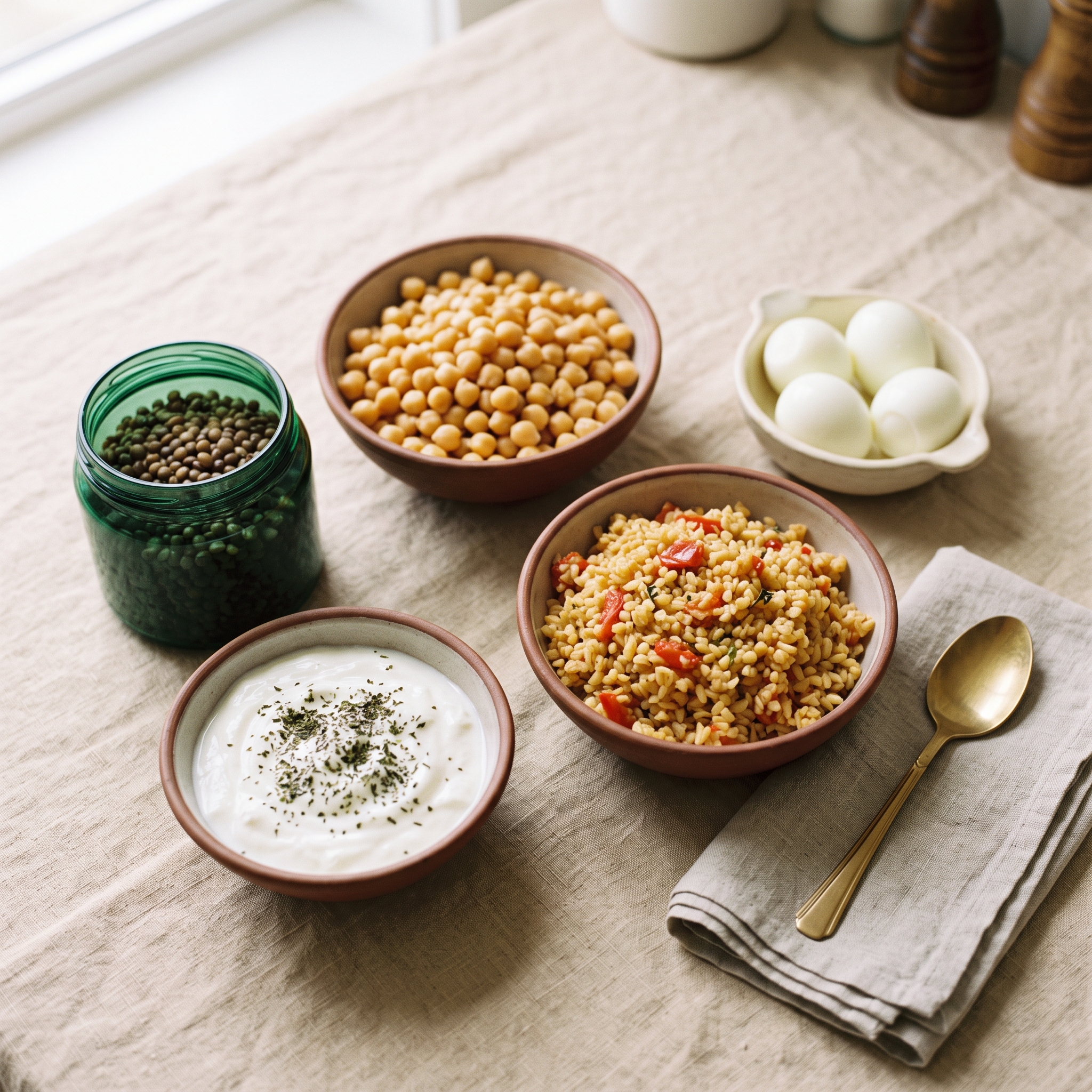
Muscle cannot be maintained without raw material. Eggs, Greek yogurt, cottage cheese, beans, lentils, fish, chicken, tofu. Getting one at each meal matters more as you age. If you want a specific daily target, a registered dietitian can set one that fits you.
4. Make your own convenience food
Convenience is the real selling point of ultra-processed food, so compete on convenience. Once a week, cook a pot of lentils or beans, a batch of a whole grain like farro or brown rice, and a few hard-boiled eggs. On a tired evening, a real plate takes five minutes to assemble.
5. Walk for 10 minutes after meals
A short walk after eating helps keep blood glucose steadier and uses your leg muscles several times a day instead of once. Even five minutes beats none. If the post-lunch slump is the problem, our 3pm crash post covers it in more detail.
6. Aim for 80%, not 100%
There is no perfect diet, and nothing in this research suggests an occasional bag of chips will ruin your knees. If most of your plate is real food most of the time, you are doing the thing that matters. Guilt is the fastest way to quit a change.
One more quiet point. Food is rarely only fuel. If ultra-processed snacks are what gets you through a long day, that is information about the day, not a failure of character. Being kind to yourself about it is part of what makes the change stick.
A one-week micro plan
| Day | Plate | Movement |
|---|---|---|
| Monday | Identify your single most-eaten ultra-processed item | 10 minutes: sit-to-stands and step-ups |
| Wednesday | Replace it with a real-food alternative | 10-minute walk after dinner |
| Friday | Batch-cook one pot of lentils or beans for the weekend | 10 minutes of strength work |
| Sunday | Ask yourself: "Which change felt easiest to keep?" | A long, unhurried walk |
When this is not the answer
This post is about prevention. If any of these apply, food changes are not enough, and you should see your doctor:
- Knee pain that lasts more than a few weeks, especially on stairs or when squatting
- Swelling, warmth or redness around the knee
- The knee locking, catching or giving way
- Morning joint stiffness lasting longer than 30 minutes
- Unexplained muscle weakness or weight loss A primary care provider can refer you to an orthopedist or a physical therapist, who can assess both the joint and the muscle strength around it. For weight, blood glucose or diet structure, a registered dietitian is a good next step.
Frequently asked questions
Does ultra-processed food cause muscle fat? A 2026 MRI study of 615 adults found that people who ate more ultra-processed food had more fat inside their thigh muscles, even after adjusting for calories and activity. Because the study was cross-sectional, it shows an association, not proof of cause.
What is intramuscular fat? It is fat that infiltrates the spaces between muscle fibers, similar to marbling in meat. It lowers muscle quality, so a muscle of the same size can produce less force. On MRI it appears as bright streaks inside the muscle.
How does thigh muscle fat affect the knees? The thigh muscles, especially the quadriceps, absorb much of the load on the knee joint. Weaker knee extensor muscles are linked to a higher risk of knee osteoarthritis, and researchers consider intramuscular thigh fat a potentially modifiable risk factor.
What foods count as ultra-processed? Under the NOVA classification, ultra-processed foods are industrial products made with ingredients not used in home cooking, like flavorings, emulsifiers and modified starches. Common examples include chips, soda, packaged baked goods, deli meats and instant noodles.
Can you reduce fat inside your muscles? Resistance training is the best-supported way to improve muscle quality. Diet quality and adequate protein likely play a supporting role, though no study has yet tested whether cutting ultra-processed food specifically reduces intramuscular fat.
Your knees carry every step you take for decades. The simplest way to look after them may be one real-food swap on your plate and ten minutes of work for the muscles that hold them up.
This article is for general information and is not medical advice. If you have joint or muscle symptoms, talk to your doctor.
If you could remove one item from your kitchen this week, which one would it be?